
Agency
by Hannah Yu-Pearson
October 2025
“Collective agency is not only the many people that share this desire and capacity to act, it is the practices, examples, histories, skills and tools that are held between them too. Collective agency makes most of what is alive and present, even if hidden, amidst us all.”
At the Centric Lab the topic of agency has been coming up a lot, and how we are coming to understand our work in advancing it as well as understanding the things that strip or challenge it. When we speak to those we work with about what has been ultimately healing in their journeys towards health justice, many share that it is a sense of agency. We asked one of our collaborators, Tim Oshodi, what makes a community healthy? And his response was -
“A healthy community isn’t one where there’s no illnesses. A healthy community is one where there’s a problem facing the community and they believe they have the capacity to bring about the change and they’re involved in that solution.”
What interests us in particular is what structures, tools, skills, conditions, relationships make the act of change possible and replicable, not just once but again and again, and not just by one person, but their community too, and not just one community, but many, all together.
What can be built to enable and hold our many singular and collective attempts at acting upon our own wills and imaginations? And what can be built to uphold agency so that a community’s sense of assertiveness does not rest entirely on any one person.

WHAT IS AGENCY?
On an individualised level, agency can be understood as having the capacity to act on one’s own will, making free choices, and being able to influence not only what goes on in our life and environment, but how we experience them too. Agency can also be understood to be when the gap between the idea and the realisation of the idea is as small as possible (link). Cultivating high agency is attributed to improved emotional health and resilience (link). However, our agency is also relational and not an individual effort divorced from context.
The context is the multiple systems that are at play in our everyday entangled lives, these extractive systems are hellbent on stripping our capacity, dignity and sense of control. These conditions shape and influence not only our real and tangible ability to make material changes in our lives, but also our sense of self and our sense of what is possible. It’s true also that we already live in a world of a few people’s imaginations, where their capacity and agency is skewed in all sorts of destructive, extractive and monopolising ways that rest on the absence and abuse of others’ capacity and agency.
Beyond the individual lies the collective, where agency is less about a productive way to improve our own individual resilience, but how we collectivise and make transformations in our lives. Cultivating reciprocity is where we experience our value, that of others, and our shared inter-dependence. Marshall Ganz defines strategy as “how we turn what we have into what we need to get what we want.” This is how agency works, it begins with what we already have. It is our shared sense of control and the shared imaginations that we make realities. It is not reliant upon any individual holding it all together single handedly (read our piece: No Time for Leaders). Collective agency is not only the many people that share this desire and capacity to act, it is the practices, examples, histories, skills and tools that are held between them too. Collective agency makes most of what is alive and present, even if hidden, amidst us all.
When the suggestion came to Portland Inn Project to open a food back in their neighbourhood, their community decision making panel chose instead to focus on food education. The young people organised the Portland Takeaway which involved them taking orders, organising budgets, learning about ingredients, working with chefs, and then delivering the meals. This process not only increased access to affordable food, it increased skill, education and experience, which in turn increased the young people and community’s ability to sustain this access to food. This is agency building in action. Agency is dignifying.
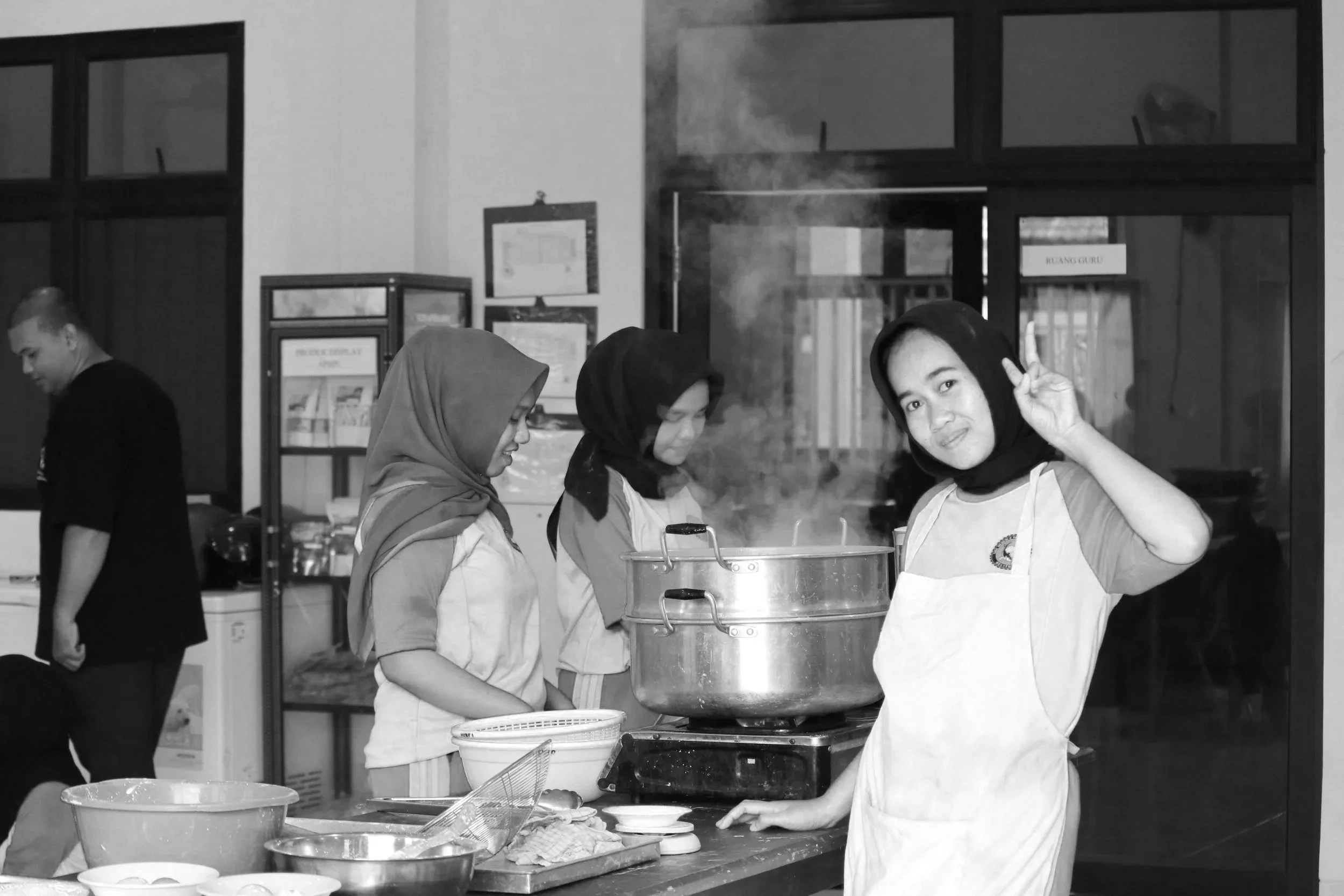
Community kitchens play a significant role in social justice by moving beyond immediate hunger relief to address the systemic causes of food insecurity, such as poverty and inequality. They function as vital social infrastructure and platforms for community empowerment, aiming to transform the broader food system into one based on dignity, solidarity, and equity.
WHY IS AGENCY AN ESSENTIAL COMPONENT FOR JUSTICE?
Of course, the onus and expectation is not on the community to provide everything for themselves whilst trying to survive in this economic and political climate. Especially when the NHS, health and social care, education, planning and public infrastructure are all services that are meant to be designed for the good of the people, to serve the people. But what is real? We know that these systems can and do fall short and cause harm. For some, there is no dignity in this interface. What do we do when the services meant to serve us fail us? What do we do when we are sick as a result of decisions made beyond us?
The very infrastructure for a more local and easeful meeting of each other’s needs and holding each other up has been decimated through the closure of community spaces, gentrification, and widespread organised abandonment. We are living in times of isolation, polarisation and social atrophy. Many of us are without community, as well as without the space, time, energy and skill to make it happen to commit to it long term. Ironically, with diminished communality we experience diminished autonomy. Without each other we are less able to act and organise in our shared interests, and ultimately our own interests too, as we depend in ever increasing amounts on external faceless systems and technologies that are unable to reflect us.
In our work at Centric Lab we have seen how the resourcing of communality and mutual witnessing can form the very first steps to increased capacity, in turn increasing agency. With intentional methodology, we have seen how the act of gathering can spark and reveal hidden skills and competencies, form baselines of knowledge and curiosity, and reveal the will and kinship that collective agency needs to move from. These are the building blocks of agency. These building blocks are then tools against community gaslighting, widening a group’s self-perception, highlighting gaps and potential avenues for consideration and action. This in and of itself is a healing pathway, and with the right resourcing can move towards health justice.
History teaches us about change, transformation and liberation, all from people organising with what they have, to secure what they need, to go where they want (an asset-based approach). How can we know what is amidst us, what we do have, if we are not with others reflecting each other? History teaches us that the moment we are in and what we have is not inevitable, there are a myriad of other possible worlds we could have ended up in, and there are still a myriad more where we can go towards.
To return to Tim’s understanding that a healthy community is one that can participate in the solution of problems, he demonstrated this in building Europe’s largest Black-led self-build housing scheme on Nubia Way that ensured social rent not only for that generation of self-builders but for their children too. This is people activating their agency and collectivising it, in deeply understanding their context and need, and then building towards resolving it. Agency unlocks more power, more potential and changes the rules of the game.
WHAT DOES SOLIDARITY HAVE TO DO WITH IT?
Our work now in observing, uplifting and seeding Healing Hubs is the next step in our journey with communities in the movement for health justice. We have observed that when communities gather in their dignity, they heal. When they heal they have a greater spaciousness and capacity to challenge the context and conditions that they are in, have a greater capacity to advocate for themselves, and to transform these conditions for themselves and others, even on the most micro scales. The key component to healing is agency, and our work now is understanding how to nurture and uphold it.
Our dear collaborator and teacher Delmy Tania Cruz Hernandez, teaches us that the core of her liberation and health justice work is the subjectifying of her people into actors of their own futures, rather than victimising them as being the objects upon which change happens. Seemingly a grammatical shift, this shift is a move away from saviourism, and to positioning her people as assertive actors of change, rather than passive receptors. Agency is this widening of choices and action. We do not just do this for ourselves, we do this for others too. Ursula K Le Guin took an imaginative step further, she wrote on subjectifying the universe, affording other kinfolk, other life forms agency. Exercising our own agency is one thing, building infrastructures of agency furthering it collectively another, affording and extending agency beyond us is another altogether.
We’d love to hear your reflections on collective agency, what has made it possible for you to act on agency, how have you extended agency?
Hannah will continue to share notes on her journey as a director of Centric Lab weaving Ecological Justice throughout the Lab’s work. At the moment Hannah is currently working on the Introduction to Ecological Health and Community Health Impact Assessment learning programmes, steering the Polluters Playbook for Air is Kin, and working with Coffee Afrik CIC on a project on memory, archiving, and ecological justice for diasporic communities. You can reach Hannah via email: hannah at thecentriclab dot com