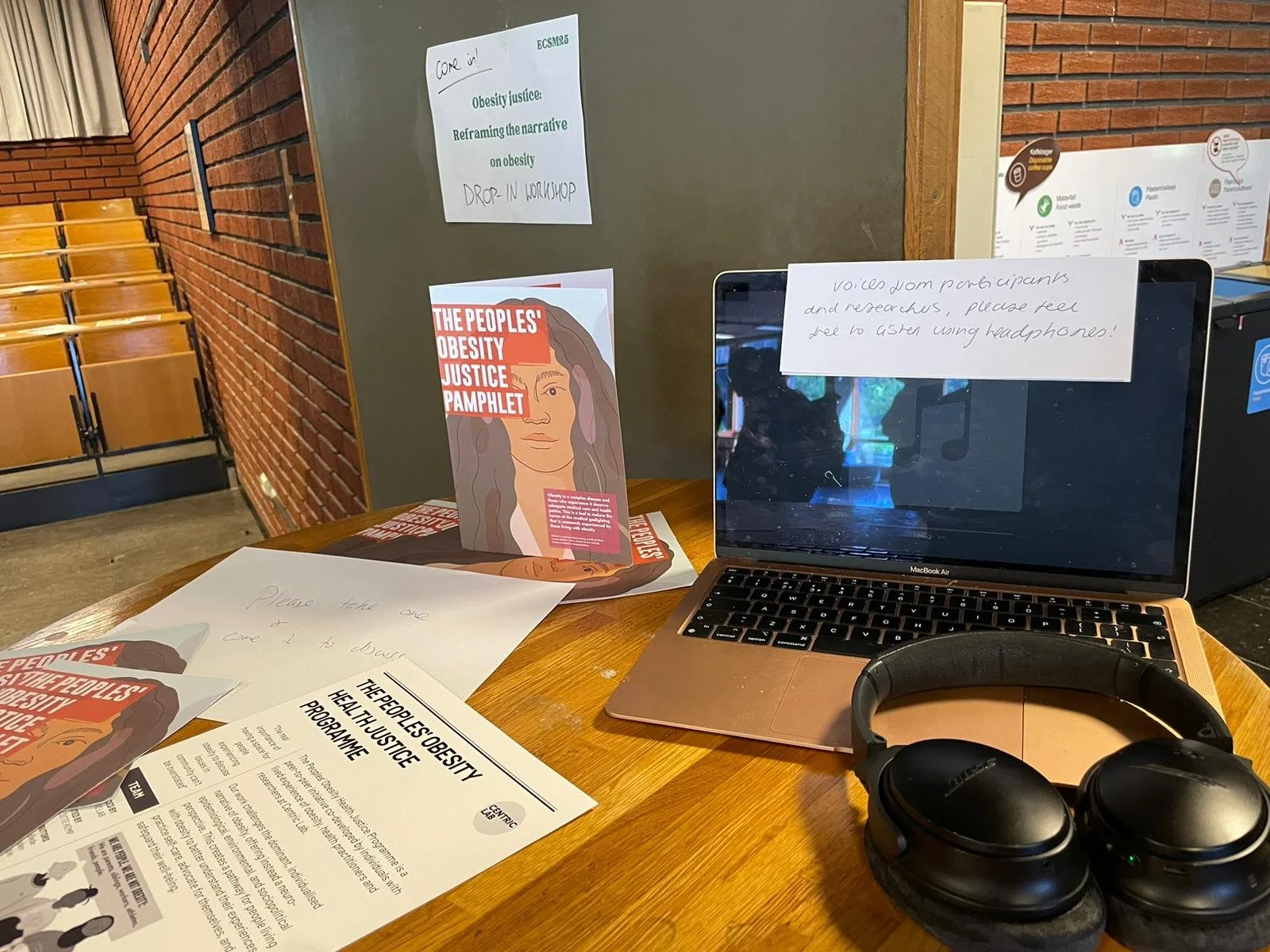
As a first step towards obesity health justice, we have created The People’s Obesity Justice Pamphlet, a resource for the people, by the people. This is a tool for harm reduction and the promotion of autonomy for people who are experiencing obesity.
Contact us if you want printed copies for your establishment, centre, place of work
We want your feedback!
Please provide any feedback about the pamphlet here. We will use this to capture the impact of the pamphlet, as well to improve and build upon this body of work.
This pamphlet is by the people, for the people and we want to hear what you have to say.
Your feedback will help us to:
Capture the impact of the pamphlet, and see how and where it's being accessed
See how we can improve and build on this work
So that we can share our learnings, we may include your feedback in Centric reporting. Please note that by filling in this form you provide consent for your data to be used anonymously as part of our reporting. We are not collecting any personal data but for the avoidance of doubt you can review Centric Lab’s privacy policy here.
Further Reading
This resource has been co-produced with healthcare professionals and people with lived experience of obesity and/or weight-related medical gaslighting to rethink how we care for people experiencing obesity.
The guide is designed as a practical tool to facilitate conversations about obesity in primary care by moving beyond a sole focus on weight and towards a broader understanding of health and wellbeing.
This report documents the development and learnings from the Community Healing Circles, part of Centric Lab’s wider Obesity Health Justice programme. It describes how the approach emerged, how the sessions were designed and facilitated, and what themes and insights arose from them. Drawing on participant feedback as well as facilitator reflections, it captures the early impact of this work and considers how the model can inform future community-led approaches to obesity health justice.
The words we choose influence how people experience care, how funding is directed, and whether people feel safe to seek support. While there are arguments for describing obesity as a disease, we have found that the term “condition” better supports our focus on inclusion and health justice.
This document provides an overview of how the pamphlet has been disseminated to date, and summarises the key themes emerging from feedback from the community.
This second report builds on last year’s pilot on micro-healing grants. One year on, we returned to the same participants — B, R, and L — to understand what had changed and/or evolved.
As a first step towards obesity health justice, we have created The People’s Obesity Pamphlet, a resource for the people, by the people. This is a tool for harm reduction and the promotion of autonomy for people who are experiencing obesity.
This work aims to demonstrate the harm of the dominant, individualised, narrative of obesity. We present an alternative understanding that views obesity through a neuro-epidemiological, environmental and sociopolitical lens. This serves as an avenue for people who are experiencing obesity to understand their disease and explore potential methods of self-care, self-advocacy and safeguarding.
Here we provide a brief overview of the creation of “The People’s Obesity Justice Pamphlet”.
Exploring the Potential of Micro-Grants as a Pathway to Healing and Health Justice for People Living with Obesity
On 11th July the cohort behind the co-designed Obesity Justice Pamphlet held an evening event with a select group to share insights, learnings, and aims of the Pamphlet. These are the 3 presentations in audio format that took place.