Towards Obesity Health Justice
There is extensive empirical evidence that obesity is a complex disease which is influenced by multiple factors, such as air pollution and trauma (Cohen & Shikora, 2020). In spite of this, medical narratives (and society at large) assume that body size can be used to predict an individual's health, is responsible for various diseases, and can be controlled through diet and exercise alone (Mauldin, May & Clifford, 2022). This, in effect places the responsibility and blame on the individuals who are experiencing obesity.
Stage 1
Developing a shared understanding and strategic focus
The review of the literature for ‘Towards Obesity Health Justice’ enabled us to generate an initial framework of understanding, the key pillars of which were as follows:
The disconnection between the neuroendocrine research highlighting the complex nature of obesity and the solely weight focussed and hyper-individualistic nature of the mainstream social and medical narrative;
The specific narrative of individualisation and blame that many patients experience whilst accessing healthcare, as well as the harm that this creates;
The lack of health inequalities analysis highlighting the socioeconomic and environmental drivers of obesity in the dominant narratives;
The lack of political health analysis to understand who benefits from a hyper-individualised narrative of obesity and corporate influence on the framing of obesity;
The lack, and importance, of the inclusion of the viewpoints of those experiencing, or impacted by, obesity.
This provided a backdrop for the next stage of the process, where we formed a collaborative working group of people with a range of backgrounds and expertise. These included people with lived expertise of obesity, cognitive neuroscientists, doctors and medical practitioners. Note that some collaborators occupied multiple of these backgrounds.
What we did:
Collaborators participated in a series of 1-2 hour roundtables which were conducted online via video call.
The aim of the first roundtable was to create a shared understanding of the current societal and medical narratives of obesity, the impact that they have and the best course of action from which to reduce their harm.
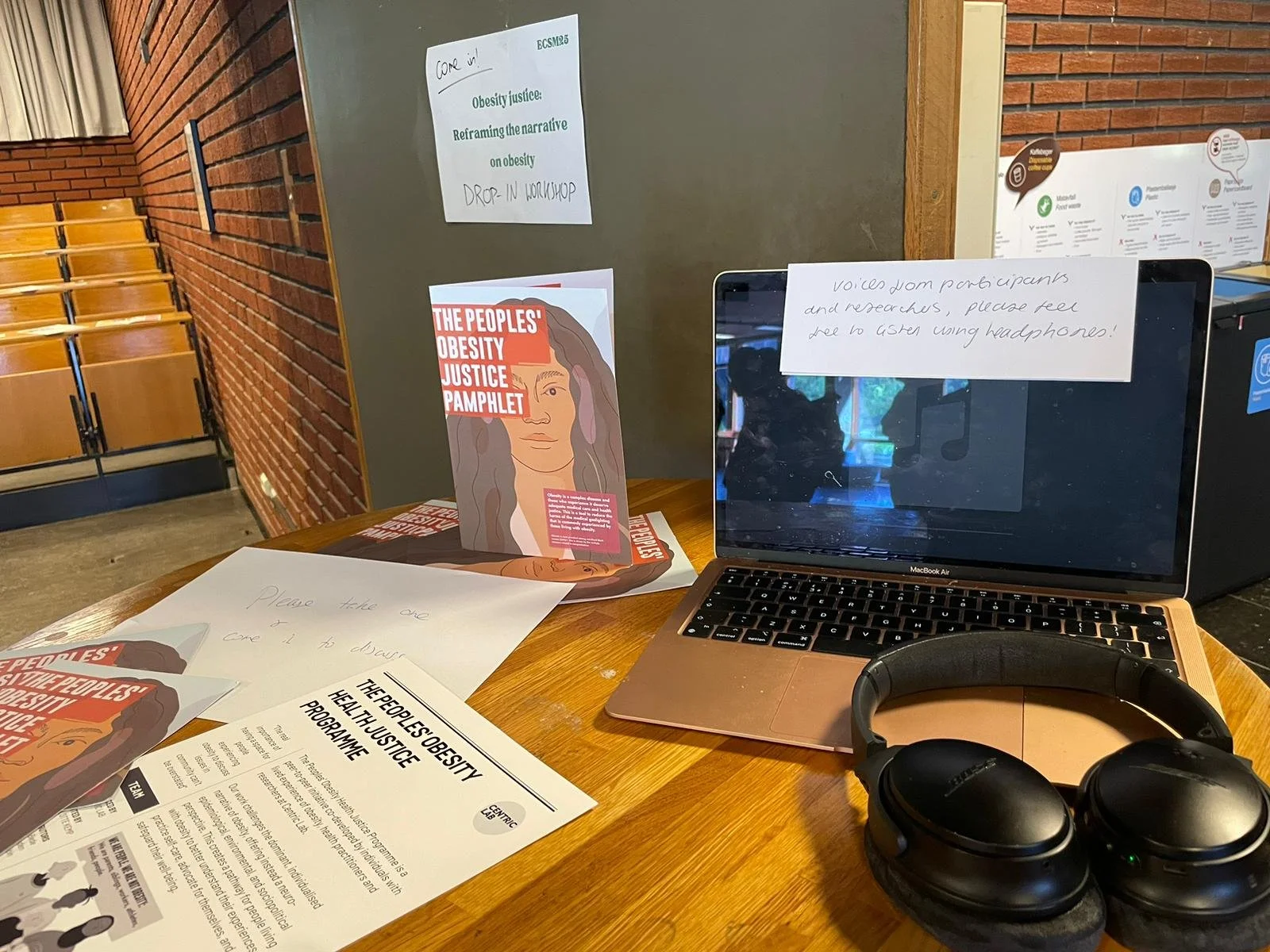
The outcome of this roundtable was a strategic focus on enabling those living with obesity to understand and challenge the dominant narrative of obesity. This was envisioned as a social justice pamphlet.
The decision to create a social justice pamphlet was due to their long history of enacting justice for various communities through spreading information that is usually not available to them.
The scientific definitions and knowledges of obesity are currently not widely accessible/ known to the general public, thus, creating a great opportunity for co-learning, awareness, and self advocacy amongst those experiencing obesity.
The inspiration was very much the pamphlet and literature created by The Black Panther Party on sickle cell anaemia, which is a disease that was prevalent in the Black community (Bassett, 2016). The medical community of the time had no interest in treating this disease or providing the community with adequate information, creating health injustice amongst many in the Black community (Smith & Vairie 2022).
Stage 2
The Creation of the People’s Obesity Justice Pamphlet
The co-creation of the pamphlet took place through a series of three further roundtables.
These roundtables consisted of a mixture of discussion and written co-working on a shared a google jamboard
Contributions were collated them into the different sections of the pamphlet and at times using direct quotes.
This meant that over 80% of the pamphlet was directly written and or influenced by the cohort. This has resulted in a pamphlet that is written by the people and for the people.
After designing the pamphlet the cohort was given the opportunity to feedback and fine-tune the contents and aesthetics of the pamphlet.
-
The aforementioned aim and sentiment behind the pamphlet was an avenue for people to understand their disease and explore potential methods of self-care, self-advocacy and safeguarding. It was highly important that was not only reflected in the final output, but in the process of creation itself. The process through which this work was created was just as important as the outputs it produced.
For this reason, each roundtable was conducted with between 5-10 members of the working group. This intimate setting enabled the creation and maintenance of a healing, non-violent and just space in which collaborators could share and be heard.
A sense of psychological safety and healing space for the members was created and maintained through the following practices, which were outlined and agreed upon before the start of the process:
Boundaries: All participants were encouraged to create clear boundaries surrounding what they felt comfortable to share and discuss. These boundaries were to be respected by all members of the group.
Promotion of kinship/ solidarity: There was a clear expectation that the space is inclusive / pro black, indigenous and multi-ethnic working class space. There was complete intolerance of any language/ actions that are not in line with the promise.
Annonyminity and informed consent: Although all contributors are acknowledged equally through authorship, no specific information is attributable to any one contributor. Further, all resources and communications were approved by all members of the group before sharing/ publication.
Further Reading