
Module 4 - A Community Health Impact Assessment
MODULE 4 | LESSON 2
Building a Theory of Change
INTRODUCTION
Building a theory of change is a traditional method of planning how your actions will have material effects.
As a process it invites you to question your methods in order to have a realistic pathway to success. It can also act as a way of encouraging stakeholders, partners, and members of the public to become supporters of your work.
With time becoming such a scarcity for people, it is responsible to ensure that when you ask people to become involved in something, it has been thought out to the point where their involvement can have a material impact they can hold onto. We should never underestimate the importance and power of the feeling of success as a motivator to try something new.
STARTING POINTS
Starting a TOC involves taking stock of what you have, where you want to go, and what you’re going to do to get there.
A simple TOC is made up of 7 parts:
A goal - where you want to get to where your problem no longer exists.
An outcome - a tangible change that has been made as a result of your actions
An output - a tangible thing that people can point to (an event or new law) or hold in their hands (such as a report)
An activity - what you do to make something happen
An input - your resources
A hypothesised solution
An identification of a problem
Each of these parts is underpinned by an assumption of yours whereby you are able to point towards an evidence. In the name of transparency, here is our working TOC for this course:
This video from Al Onkka is a simple explainer about how a TOC works.
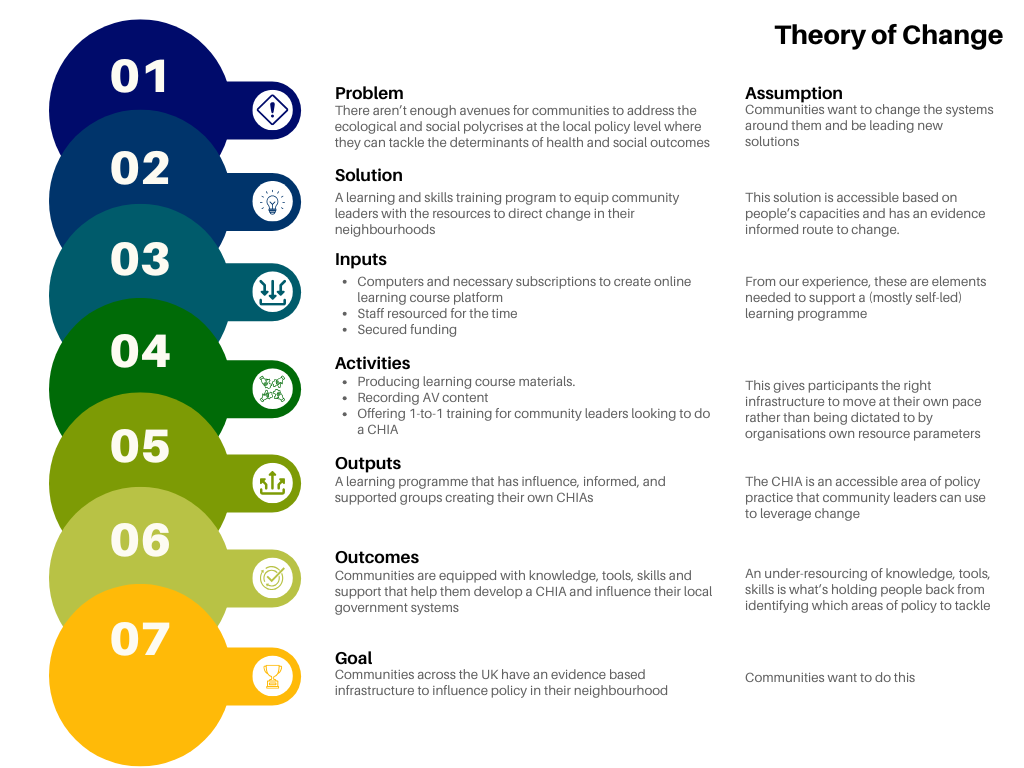
Hopefully, you can see that in our case each step is relatively linear and underpinned by an informed assumption from our experience or knowledge. Each step in a TOC should feel like walking up a staircase, it may get harder but it’s relative and follows a process.
Learning Points
-
Perhaps the hardest part in defining the elements of a TOC is matching them to our agency. We’ve framed this challenge by looking at it from the perspective of a small and large organisation.
Smaller organisations
It’s important to relate our goal to our agency. For example, it would be remiss of Centric Lab to believe it can change the NHS through one plan given our size, resources and skillsets. However, we know that we could change the behaviour of one system within the NHS that can contribute to wider systemic change led by larger organisations, as such we become a part of a wider ecosystem of changemakers who can be important to us, and vice versa, in our efforts. Therefore, when thinking about the ‘goal’ and ‘problem’ we should set them according to our agency and make sure they’re aligned. For example, a goal should be within reach such as ‘ensuring the local government acknowledges climate impacts on population health’ and the problem is ‘people’s health is not being considered in response to climate change’.
Larger organisations
Larger organisations often do have the time, resources, and skills to tackle bigger problems and set goals higher. They may work on these issues for multiple decades leveraging their resources for political influence and legal/regulatory change. For example, a large NGO nature charity’s goal may be set on ‘abolishing forever chemicals from bodies of natural water. This is a big goal however it’s set to their organisational capabilities and they may see the problem as ‘politicians are not organised and informed enough to vote on new Acts of Parliament that concern environmental regulation, and the solution as ‘a cross-party parliamentary group where a number of MPs are able to become informed leaders influencing colleagues and championing new bills that reflect the needs of their constituents and the wider population’.
Framing your goal, problem, and solution accurately to you and your organisation is key to a successful theory of change.
-
These are typically more direct in writing out, they are how you operate.
Your inputs towards a project are your resources. It’s an accounting method of acknowledging what you need for a project to be successful. For example, if you’re recording music you’ll need instruments, equipment, and a place to record.
Your activities are the actions you take to create an output. For example, if you’re writing a report that summaries people’s lived experiences of living near motorways, one of things you might do is to interview a range of people, that’s an activity.
Your outputs are often quantifiable and tangible things. For example, an output can be a printed report used for circulation or event series with a wide range of people. An output can also be something like therapy sessions for people.
Your outcomes are the immediate results of the outputs. For example, the outcome of sharing a report to politicians is the (expected) belief that politicians will be more informed on issues related to, say, forever chemicals pollution.
-
Use the template provided, or write out your own, to start piecing together a TOC. It’s good to try by yourself at first, then share with another person from your group, then perhaps someone who’s not in your group or an evangelist of your cause in order to test out whether they think it makes sense - this is often where your ‘assumptions’ will be tested. Once you have the feedback you can edit and then present to potential stakeholders, partners, and wider community folk you want to bring on board to your project.
You can download a TOC worksheet via the button here and start working on your own

“When thinking about the ‘goal’ and ‘problem’ we should set them according to our agency and make sure they’re aligned. For example, a goal should be within reach such as ‘ensuring the local government acknowledges climate impacts on population health’ and the problem is ‘people’s health is not being considered in response to climate change.”
KEY LEARNINGS
A Theory of Change model is a great way to hold yourself accountable and to bring others into your mission.
Assumptions must be practical rather than overreaching or bias
CONSIDERATIONS AND REFLECTIVE QUESTIONS
Has your Theory of Change model exposed an area of weakness in your plan? Are there people you know who can help you address it?
Explore other examples to see how people have considered the steps they’re taking. This will help you understand whether steps are too ambitious, or not ambitious enough.