
Module 4 - A Community Health Impact Assessment
MODULE 4 | LESSON 3
Creating a Community Health Impact Assessment
INTRODUCTION
What makes up community health, and what are the impacts of an intervention?
Such as large scale property development in a dense neighbourhood, the introduction of a new set of policies, or the impacts of climate change. To do this, it’s important to understand what supports the community to be healthy?
Step by Step Process for Creating a CHIA
Health is more than our access to healthcare, it’s influenced by various top-down and societal factors. Therefore, when considering how to collect this information it is important to have a good facilitation technique that helps people express what are points of stress and what are points of wellness.
Organising Conversations
A method that we use is to organise conversations with your community under 5 domains: economic conditions, social dynamics, built environments, political environment, and lastly approaches to wellbeing and healthcare. Under these domains you can hold conversations asking people about their views on what within these factors contributes to a state of wellbeing and health (based on lower stress levels)
Giving Space for Thinking
Key to this facilitation is ensuring people are given the license to think holistically about their daily, weekly and monthly interactions with systems. In particular, it’s important to centre thinking on factors that increase or decrease their exposure to environmental or psychosocial stressors.
Scenario Modelling
One good exercise here is to start with asking people to think about themselves. Then start scenario playing similar situations with someone who they know is more vulnerable to impacts, this could be an older relative with mobility issues or a child’s friend who has some learning challenges. Lastly, ask them to consider whether there are demographics not yet considered who’s challenges haven’t been thought about.
Organising Factors into Domains
At the end of this you should have a wide range of factors that people have shared about what contributes to their health. Within each main domain you may start to see some factors overlap, therefore under your domain of ‘built environment’ there may be a number of indicators of health for housing, for transport, for waste management, etc.
Setting up Metrics
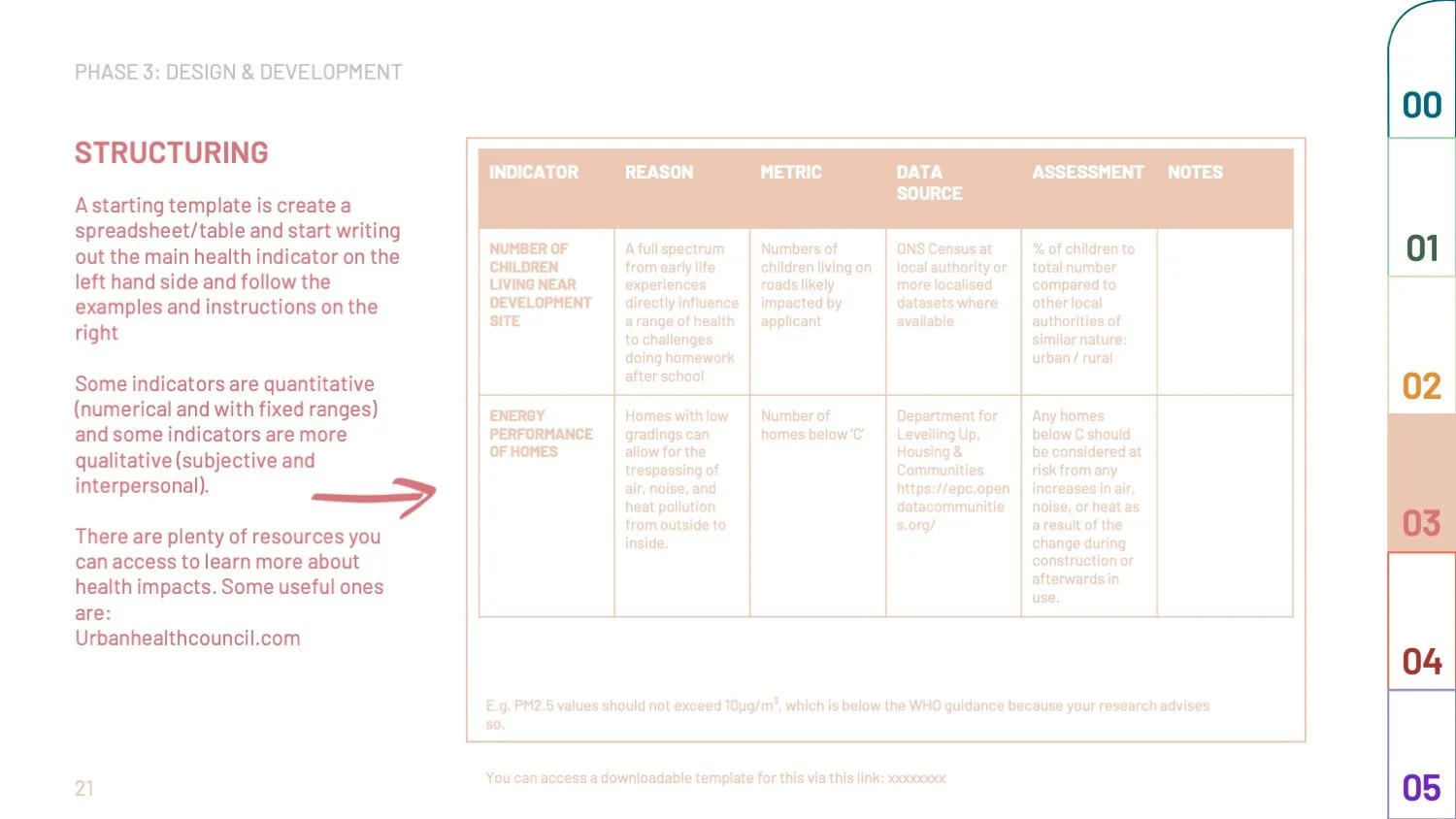
Once you have your indicators in place you’ll want to set some metrics against them as a way of clarifying whether an activity can be evaluated as an issue of urgency or impact. A metric is a quantitative way of measuring. For example, in Southall when the CASH community group were producing their CHIA a key indicator they wanted property developers to be acting on was the number of children in and around the construction zone. This was because from their experience construction noise was preventing children from doing homework. This impacted leisure time and the inter-family dynamics
Setting Values
In cases when you’re presenting non-human data, such as the numbers of non-mainstream food stores in an area, it's useful to have high/medium/low ratings. This can help point out whether an area is chronically undersupported by resources and services.
Creating Your Draft Assessment
At the end of this exercise you are expected to have a spreadsheet style list of domains, topics, indicators, metrics and data sources that people can go to in order to do the assessment. We have provided an example of how this can work.
To help this process we have designed a facilitation toolkit. This covers issues such as working agreements, role assignments, how much time is needed, as well as thoughts about putting the CHIA into use with stakeholders and related parties.
-
The number of children in and around the construction site (in the context of noise preventing children from completing homework) was a metric that impacted leisure time and the inter-family dynamics. In the short term, this introduced challenges of needing a new location for after-school work, which brought in other challenges related to childcare such as the carers mobility issues, numbers of children being cared for at any time, and travel arrangements to new locations. Over a long period of time, children who suffer at school will face negative experiences that can impact them as time goes by. Therefore, the CASH community wanted property developers and construction companies to calculate through census data, and door knocking for surveys, whether there were children in the area - this would not only give a quantitative data point to a qualitative problem but would also emphasise the message of construction disruption to the companies and that there were people with complex lives living around their project. CASH felt that had these types of data led issues been brought up through a HIA done in partnership with the community beforehand, they could have co-created solutions with the developers, construction company, and local authority. Instead, their experience was that this issue was not a factor related to health and as such ignored, resulting in children and carers living through difficulty for long periods of time with no way out - a type of psychosocial stressor.
A little safeguarding when it comes to trying to change policy
It’s important to note that due to politics, it’s quite hard to change policy. Therefore, you may not find your CHIA is adopted into local government or authority practice as gospel. However, producing your own CHIA is as much about changing dialogue as it is practice. This area of work intends to change the narrative on community health and the impacts that changes make to it. Over this programme we have hopefully communicated a number of weaknesses within incumbent systems and ideological framings that a CHIA can address. A CHIA exposes to interested parties how community health is shaped in reality rather than through report. Therefore, you become an agent of narrative change through your practical work and may find that new solutions can be put forward to address an unfair current dynamic. For example, you may find that changes to governance and civic-engagement on policies are introduced or a greater relationship is triggered between local authority departments (such as public health and equalities teams). Whilst the goal is a CHIA in all policy, sometimes the journey can reveal new paths. When covering issues about people’s livelihoods and their health and wellbeing, we must also take responsibility for seeing wins when they present themselves rather than burn out in vain of glory. Be prepared for doing a CHIA to be a trojan horse to social impact and justice.
Tip: Go back to your Theory of Change and have a think about what other wins can occur as a result of this work. When you go into a situation where power dynamics are against you, you still want to walk out with a win. Every win is a shining example of what happens when communities come together to imagine how things can be better and in the words of Dr. Patrick Williams “show the authorities as the fools that they are for not having already done what you’ve done in your spare time”.
KEY LEARNINGS
A Community Health Impact Assessment considers the current health and wellbeing conditions people value as well as those they are forced to deal with.
A CHIA should be fair, non-bias or partisan and embody the 4 principles from the World Health Organisation: democracy (promoting stakeholder participation), equity (considering the impact on the whole population), sustainable development and the ethical use of evidence.
A CHIA is designed to improve communication between authorities, changemakers, and communities. It can be a pathway to communities organising their health related demands that may stretch beyond the current authority they’re interacting with and into others.
CONSIDERATIONS AND REFLECTIVE QUESTIONS
Has your CHIA embodied the WHO four interlinking values?
Can someone else use your CHIA easily and deliver an assessment without your oversight?
Have you tried using the CHIA yourself on a few topics to see what the results look like?